A piece of bread sweetened with cocoa and sugar makes a little bright-eyed girl smile. The chocolate spreads, it sizzles. Walnuts complement their sweetness with the fractals in their folds and crevices. The scoop of vanilla ice cream breaks like an avalanche, and eventually, from hot to cold, it melts.
“Why? Why does the ice cream want to take a swim? Why does this smoke dance with the wind?” she asks.
These instances, and this question, as innocent and simple as they seem, once left humanity bewildered.
Before machines and equations, we watched the world change its seasons and colours, water shift forms from clouds to snowflakes, flames flicker from rubbing two stones, and when seeds sprouted up. We experienced transformation all around us and wondered why; these phenomena mesmerised us, but we did not have the words to describe them. Why does warmth flow from flame to flesh? Why does structure dissolve into chaos, and chaos into life? In every spark, every breath of wind, we were interacting with a beautiful law, one that the universe had kept a secret, which was soon to be told.
In 1850, Rudolf Clausius, while wondering the same question, stumbled upon an idea which he called “entropy”. What everyone considered a way of the universe was given a name, and it answered many of our questions.
Entropy is a measure of the distribution of energy, and it determines why energy only moves in one direction. A balloon once deflated does not fill itself with air naturally, and a flame burnt out does not light up again, as energy once concentrated will always spread out. While this discovery marked a scientific revolution, it also silently began shaping our understanding of the world: that every act of creation, including life, comes at the cost of spreading energy, and that this spreading is not destruction, but the very process through which beauty and existence come about.
“What is the purpose of life?”
We ask ourselves,
“What really is it?”
Not the individual purpose that each one of us seeks, but the very reason of our existence. Why are we here?
Ice melts, eggs hatch, life emerges on earth; plants sprout up from parched soil; fireflies flicker to light up corners, and we flow down the river in ashes. All of this happens at the same time, on the same planet, following the same laws. Dancing to the steps of the universe. There must be a reason.
To some, we may not be here for any reason at all. Could we have spontaneously emerged from the right conditions of temperature, pressure, and concentration? Yet, to add to our surprise, spontaneity and reason can go very well together.
Gerald Joyce, a physician and current professor at the Salk Institute for Biological Sciences once said, “We are just self-sustaining chemical systems capable of Darwinian Evolution”, which to me seems like a hint at our purpose.
The fact that we have sustained for so long and continue to evolve, like all other species on this planet, suggests that we are not struggling to keep up with the universe but are existing because of it and its laws of thermodynamics. To me, it feels like these laws are what define the purpose for all of life on earth. Thus, our existence has a shared purpose.
In “The Big Picture: On The Origins of Life, Meaning and The Universe Itself”, Sean Carroll talks about how we might just be a consequence of the second law of thermodynamics which states that all energy in the universe tends to dissipate, and order tends to turn into disorder. To many, this suggests that all organized structures, all the complexity in the universe, will eventually turn to rumbles and disintegrate. However, it is during the dissipation of energy that complexity arises.
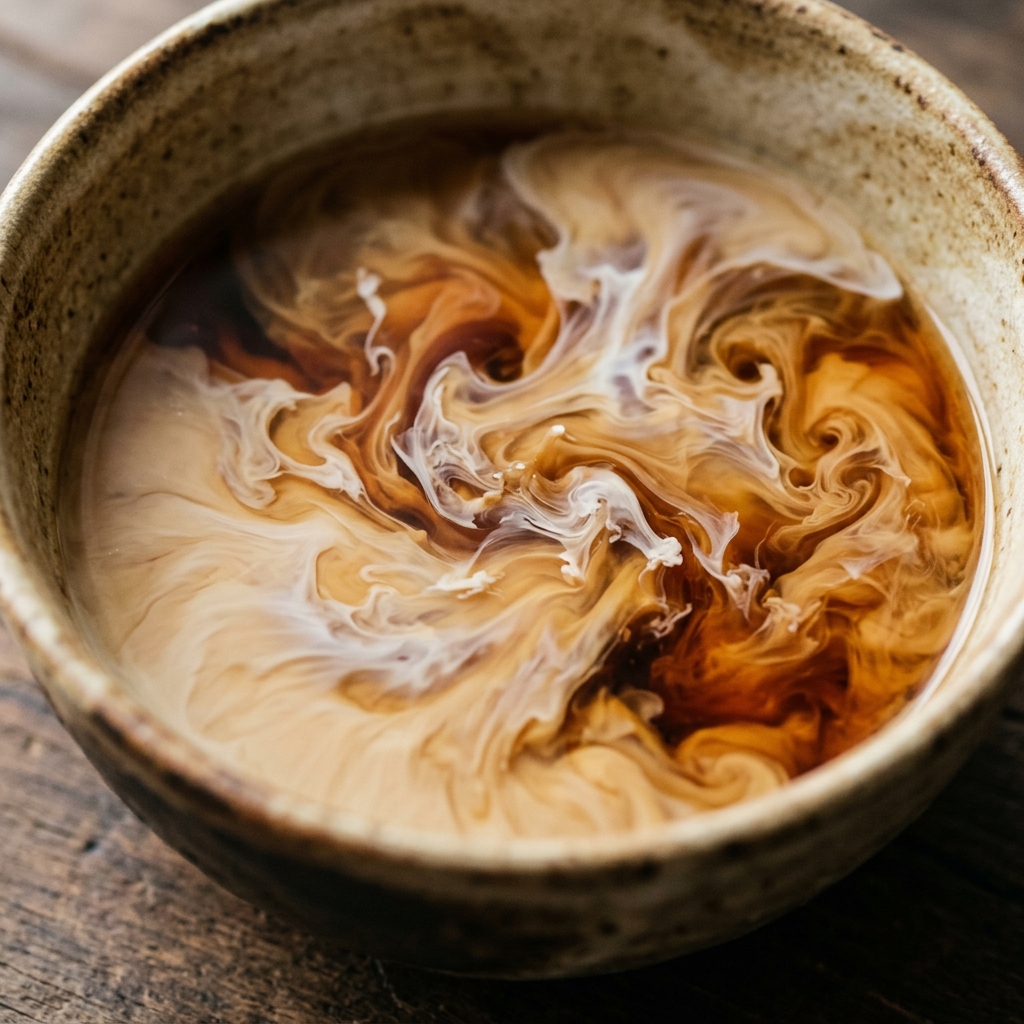
Take a glass half-filled with tea and the rest with milk. At its initial stage, it looks really simple. You can easily distinguish between the layers of milk and tea. At the end, after both have been mixed, all you see is tea and milk blended together. A simple, single layer of milk tea. Yet, in between these stages is where you see beauty. In a brief moment, we see swirling, intricate, complicated patterns. That’s us! We are the interesting part of the universe right now. Brimming with complexity and life, adding colours to our otherwise simple and plain cosmos.
From Clausius’s equations for engines to today’s theories on life, the idea of entropy has helped us discover a common purpose. As we continue to learn and move forward, entropy reminds us that meaning does not necessarily emerge despite chaos, but through it.
We, life on earth, stars, and even distant galaxies, arose through the universe’s pursuit of increasing entropy. In fact, every civilization, every organism, every particle, and every reaction has been part of the universe’s pursuit of increasing entropy.
Entropy, which started as a scientist’s concern, has ended up becoming a philosopher’s fancy. Today, it adds another layer to our understanding of evolution, sustenance, and our place in time. It also helps us realise that we are part of something much larger than ourselves; we are the ripples in a massive wave, like the supernovae and nebulae. We are here to help the universe in its journey and to simply continue the mission of the stars.
Bibliography
Saslow, Wayne M. “A History of Thermodynamics: The Missing Manual.” Entropy, vol. 22, no. 1, Jan. 2020, p. 77. https://doi.org/10.3390/e22010077.
Gowlett, J. a. J. “The Discovery of Fire by Humans: A Long and Convoluted Process.” Philosophical Transactions of the Royal Society B Biological Sciences, vol. 371, no. 1696, May 2016, p. 20150164. https://doi.org/10.1098/rstb.2015.0164.
Carroll, Sean M. The Big Picture: On the Origins of Life, Meaning, and the Universe Itself. 2016, cds.cern.ch/record/2152403.